

Introduction
So you’ve decided to go freelance—congratulations. Now comes the question that trips up almost every new freelancer: Which platform should I start on? If you’ve been searching “Upwork vs. Fiverr” trying to figure out where to start, you’re not alone.
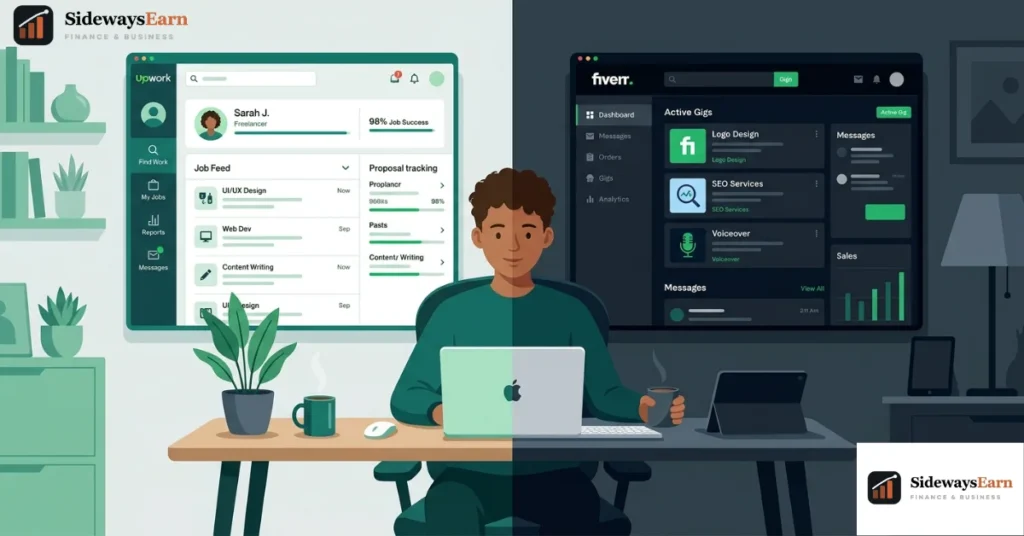
Upwork vs. Fiverr is one of the most debated comparisons in the freelancing world, and for good reason. Both are legitimate, well-established online freelancing platforms with millions of active users. But they work very differently, attract different types of clients, and reward different kinds of freelancers.
If you choose the wrong one to start with, you could spend months with zero traction — not because your skills are lacking, but because the platform isn’t structured in your favor as a beginner.
This guide breaks down both platforms honestly so that you can make the right call from day one.
What Is Fiverr — And How Does It Work?
Fiverr is a gig-based marketplace where freelancers (called “sellers”) create service listings called “Gigs.” Buyers browse these listings and place orders directly — no bidding, no proposals, no cold pitching.
When you sign up and create a gig, you’re essentially setting up a mini storefront. You define your service, set your price, write a description, add samples, and wait for buyers to find you.
Why Fiverr Works Well for Beginners
Fiverr gigs for beginners have a major advantage: you don’t need to pitch anyone. If your gig is set up well and you land a few early reviews, the platform starts pushing your listing in search results.
This passive, inbound model works especially well for:
- Creative services — logo design, video editing, voiceovers, illustration
- Writing and content — blog posts, product descriptions, résumés
- Digital marketing — social media management, SEO audits, email templates
- Tech tasks — WordPress fixes, data entry, simple coding jobs
The barrier to entry is low. You can sign up for free, create your first gig in under an hour, and theoretically receive an order the same week—if your niche has demand and your profile looks professional.
The Downside of Fiverr for New Sellers
The biggest challenge on Fiverr is visibility. With millions of active gigs on the platform, getting your listing found in a competitive category is hard without initial reviews. Fiverr’s algorithm strongly favors sellers with completed orders and high ratings, creating a classic chicken-and-egg problem for newcomers.
One workaround: start with a very specific, low-competition niche rather than going broad. Instead of “I’ll write blog posts,” try “I’ll write blog posts for SaaS B2B companies. Specificity reduces competition and attracts better-fit buyers.
What Is Upwork — And How Does It Work?
Upwork operates differently. It’s a proposal-based freelance marketplace where clients post jobs and freelancers submit proposals to compete for them. Think of it less like a storefront and more like a job board where you actively apply for gigs.
Upwork supports both short-term projects and long-term contracts, with options for hourly or fixed-price work. Clients range from solo entrepreneurs to Fortune 500 companies.
Upwork Beginner Guide: Getting Started
Creating a strong Upwork profile is more involved than setting up a Fiverr gig. You’ll need:
- A professional headline that clearly states what you do
- A detailed overview that speaks to client pain points
- Portfolio samples (even personal or mock projects work at first)
- Skills tags that match high-demand keywords
- A competitive (but not dirt-cheap) rate
Once your profile is live, you use “Connects”—Upwork’s internal currency—to submit proposals. Free accounts get a limited number of Connects per month, and additional Connects can be purchased.
Why Upwork Is Powerful (But Harder for Beginners)
Upwork’s biggest strength is client quality and deal size. Many clients on Upwork have real budgets and are looking for professionals, not just the cheapest option available. Long-term contracts are common, which means a more stable income over time.
The downside? It’s competitive. Without a job history on your profile, clients may skip over your proposal in favor of someone with 50 five-star reviews. This is the most common frustration new freelancers face on the platform.
That said, it’s not impossible. A well-crafted, personalized proposal can absolutely beat a generic one from someone with more experience. The key is to write proposals that speak directly to the client’s specific problem—not just a copy-paste pitch about your skills.
Upwork vs Fiverr: Side-by-Side Comparison
Here’s a quick breakdown of the core differences:
|
Feature |
Fiverr |
Upwork |
|---|---|---|
|
How work is found |
Buyers find you |
You apply to jobs |
|
Effort to start |
Low |
Medium–High |
|
Competition for beginners |
Moderate |
High |
|
Average project size |
Smaller |
Larger |
|
Long-term contracts |
Rare |
Common |
|
Platform fee |
20% |
20% (sliding scale) |
|
Best for |
Creative, quick-turn tasks |
Professional services, ongoing work |
Both platforms charge around 20% in service fees at the entry level, so pricing parity isn’t a deciding factor here.
Which Platform Should a Beginner Choose?
The honest answer: it depends on what you’re offering and how you prefer to work.
Choose Fiverr If:
- You offer a clearly defined, deliverable-based service
- You prefer inbound work without writing proposals
- You’re in a creative or content-focused niche
- You want to start earning faster with less friction
- You’re comfortable with smaller, transactional jobs initially
Choose Upwork If:
- You offer consulting, strategy, or technical services with higher price points
- You’re willing to invest time writing strong proposals early on
- You want to build long-term client relationships
- Your niche has well-paying clients who budget properly (software development, finance, marketing)
- You have a portfolio to show, even if it’s from personal projects
For most beginners — especially those without an existing portfolio — Fiverr is the easier starting point. The lower barrier to entry means you can collect reviews, refine your service offering, and build confidence before moving to a more competitive platform.
That said, the best freelancers eventually operate on both. Using Fiverr to build your reputation while simultaneously testing Upwork proposals is a smart strategy once you find your footing.
Related read: If you’re still figuring out what to offer on either platform, check out our guide on the best freelance skills to learn for high income—it’ll help you pick a niche with real earning potential before you set up your first gig or profile.
Practical Tips for Getting Your First Client on Each Platform
Understanding the Upwork vs. Fiverr dynamic before picking a platform saves you weeks of wasted effort.
On Fiverr:
- Research your category’s top sellers and study their Gig structure
- Use all five Gig images and create a short intro video if possible—it dramatically improves conversion
- Start at a competitive but not underselling price (going too cheap attracts difficult buyers)
- Offer a fast delivery window early on to boost your search ranking
- Ask satisfied clients for reviews—Fiverr’s algorithm is review-driven
On Upwork:
- Spend your first Connects wisely—only apply to jobs where you genuinely match the requirements
- Personalize every proposal: reference the specific project details the client mentioned
- Apply to newer job postings (under 10 proposals) for better odds
- Use the cover letter to solve one problem right away—show, don’t just tell
- Consider taking Upwork Skill Certifications to boost profile credibility
FAQs: Upwork vs Fiverr for Beginners
Q1: Is Upwork vs. Fiverr still a relevant comparison for beginners in 2026? Yes, absolutely. Many freelancers run profiles on both platforms simultaneously. There’s no rule against it, and diversifying your income sources is generally a smart move once you’re comfortable managing client expectations on both.
Q2: Which platform pays more — Upwork or Fiverr? Upwork tends to have higher average project values, especially for technical and consulting work. However, Fiverr sellers with premium packages in high-demand niches can earn just as well. It ultimately comes down to your niche, positioning, and how well you communicate your value.
Q3: Is it hard to get approved on Upwork? Upwork has an approval process that vets new freelancers before they can submit proposals. Profiles are reviewed, and some are rejected if they appear incomplete or low-quality. A professional photo, a detailed overview, and clear positioning of skills massively increase your chances of approval.
Q4: How long does it take to get the first order on Fiverr? It varies widely. Some sellers receive their first order within days; others wait weeks. The key factors are niche demand, gig quality, and pricing. Niches with high search volume and fewer top-rated sellers tend to move faster for newcomers.
Q5: Which is better, buyer quality, Fiverr, or Upwork? Both platforms have a mix. Upwork generally attracts clients with defined budgets and longer-term needs, while Fiverr can attract bargain hunters — especially in lower-priced categories. Clear positioning and professional pricing on either platform naturally filter for better clients.
Conclusion
The Upwork vs. Fiverr debate doesn’t have a single right answer—but it does have a better starting point depending on your situation.
If you want the fastest path to your first paid freelance work, Fiverr’s gig-based structure gives you that. Set up a focused, well-presented gig in a specific niche, and you can be earning within your first few weeks.
If you’re willing to invest more upfront effort and you have skills that command higher rates, Upwork’s proposal model has a higher ceiling—and the ability to build stable, recurring client relationships.
Start with one, master it, then expand. The freelancers who do best on these platforms aren’t the ones who signed up everywhere on day one — they’re the ones who went deep on one platform until they understood it, then scaled.
Pick your platform, commit to it, and focus on delivering exceptional work. That’s still the only strategy that wins long-term.
External Reference: For an independent look at freelance platform statistics and market data, the Payoneer Freelancer Income Report offers annually updated benchmarks on freelancer earnings across platforms worldwide.