
Introduction
Here’s something most people don’t realize until they’ve already spent months grinding freelance work or dropshipping physical goods: the most scalable way to earn money online doesn’t involve inventory, shipping, or trading time for dollars.
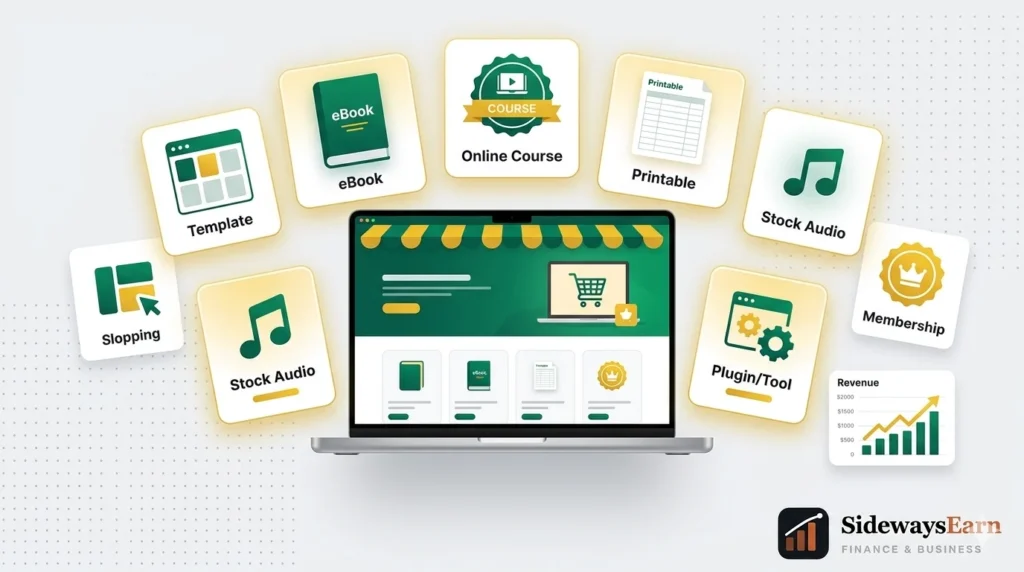
Digital products to sell are, simply put, the smartest category of online business for anyone who wants to build income that doesn’t stop when they do. You create something once. You sell it hundreds—sometimes thousands—of times. No restock. No warehouse. No refund nightmares over broken packaging.
But not all digital products are created equal. Some are saturated. Some require skills most beginners don’t have yet. And some are genuinely underutilized opportunities sitting in plain sight.
In this guide, you’ll learn exactly which digital products are worth your time, how to create them even if you’re starting from zero, and which platforms give you the best shot at actually making sales.
Why Digital Products Are One of the Smartest Online Business Models
Before getting into specific ideas, it’s worth understanding why this model works so well—not just in theory, but in practice.
When you sell digital downloads online, your cost of goods is effectively zero after the initial creation. A $27 Notion template you designed in an afternoon can sell 500 times with zero additional effort. A $197 online course can generate revenue while you sleep, travel, or work on your next product.
Compare that to physical products: storage, fulfillment, shipping delays, returns, and supplier relationships. Digital wins on every axis except one — you have to actually create something worth buying.
That’s the real challenge, and it’s what this guide is built around.
Best Digital Products to Sell Online
1. Templates (The Fastest Path to Your First Sale)
Templates are the single most beginner-friendly category of profitable digital product ideas. Why? Because people are already searching for them, they’re fast to create, and they deliver instant value.
Think about what people need templates for:
- Notion dashboards for productivity, project management, or habit tracking
- Canva templates for social media posts, pitch decks, and media kits
- Excel and Google Sheets budget trackers, content calendars, and invoice templates
- Resume and LinkedIn templates for job seekers
- Email sequence templates for marketers and founders
A well-designed Canva template pack on Etsy or Creative Market can generate consistent passive income with very little ongoing effort. The key is specificity — a “social media template for real estate agents” will outsell a generic “Instagram post template” every time because it speaks directly to a defined buyer.
How to start: Pick a niche you understand. Design 10–20 cohesive templates using Canva or Figma. Bundle them, write a clear product description, and list on Etsy or Gumroad.
2. Online Courses and Workshops
If templates are the fastest start, online courses are the highest ceiling. This is one of the most consistently passive income digital products because a single course can generate revenue for years.
The mistake most beginners make is thinking they need to be a world-class expert. You don’t. You need to be a few steps ahead of your target student and be able to explain things clearly.
Platforms like Teachable, Kajabi, and Podia handle the technical side — hosting, payments, student management — so you can focus on content. For shorter, lower-priced workshops, Gumroad and Maven work equally well.
What sells:
- Skill-based courses (Photoshop, Excel, coding basics, copywriting)
- Process-based courses (how to start a podcast, launch a freelance business, build a Shopify store)
- Transformation courses (fitness, mindset, productivity systems)
The most important factor is a specific outcome. “Learn Canva” is weak. Create a Professional Brand Kit in Canva in One Weekend is a product people will pay for.
3.
Best Digital Products to Sell Online
eBooks and Digital Guides
eBooks have a reputation problem — mostly because the internet is full of thin, low-effort PDFs that don’t deliver real value. That’s actually good news for you, because a genuinely useful, well-written guide stands out immediately.
The best-selling digital guides aren’t long. They’re thorough on a narrow topic. A 40-page guide that solves one specific problem will outsell a 200-page general overview every time.
Tools to create them: Notion (export to PDF), Google Docs, Canva (for designed layouts), or Adobe InDesign for premium formatting.
Where to sell: Gumroad, Amazon Kindle Direct Publishing (KDP), Payhip, or your own website via WooCommerce or Shopify’s digital downloads app.
A niche eBook on, say, “cold email scripts for freelance designers” will find its audience faster and convert better than a broad guide on “how to make money online.”
4. Printables
Printables sit at an interesting intersection: they’re digital products, but buyers print and use them physically. Wedding planners, teachers, parents, and small business owners are constantly buying printables on Etsy.
High-selling printable categories:
- Planners and journals (daily, weekly, goal-setting)
- Kids’ activity sheets and learning worksheets
- Budget and finance trackers
- Wedding and event planning checklists
- Wall art and motivational prints
The profit margins are excellent because the production cost is zero. A $5 printable planner sold 300 times is $1,500 with minimal ongoing work. Sellers who build cohesive “planner bundles” or seasonal collections consistently outperform single-listing stores.
Canva is the go-to tool here, though Adobe Illustrator gives you more control for complex designs.
5. Stock Assets (Photos, Music, Video, and Fonts)
If you have creative skills—photography, music production, motion graphics, or type design—stock assets are one of the most scalable, sellable digital download models available.
Platforms like Shutterstock, Adobe Stock, Pond5 (for video and audio), and Creative Market (for fonts, graphics, and UI kits) pay you royalties every time someone licenses your work. Upload once, earn indefinitely.
The caveat: stock markets are competitive. Creators who do well focus on underserved niches—specific industries, visual styles, or audio moods that are searched for but underserved.
6. Software, Plugins, and Digital Tools
This is the highest-effort category but also the one with the most recurring revenue potential. Chrome extensions, WordPress plugins, Figma plugins, Notion widgets, and SaaS micro-tools can generate subscription income that compounds over time.
You don’t necessarily need to build it yourself. Many successful product creators work with freelance developers to bring their ideas to life, then handle marketing and support themselves.
Examples of micro-tools that sell well:
- SEO audit tools for bloggers
- Social media scheduling scripts
- Invoice generators for freelancers
- Grammar or tone checkers for specific niches
If you’re a developer, this is worth serious consideration. Platforms like Gumroad, Lemon Squeezy, and Paddle make selling software products straightforward.
7. Memberships and Digital Communities
Rather than selling a product once, a membership model lets you charge monthly or annually for ongoing access. This could be a private community, a content library, monthly templates, coaching calls, or all of the above.
Tools like Circle, Mighty Networks, and Patreon make this relatively simple to set up. The key is delivering consistent value that justifies the recurring charge — members will churn fast if the community goes quiet or the content gets stale.
For a deeper look at how to structure and price a digital product business from the ground up, check out our guide on building a passive income business online for a complete framework.
How to Create Digital Products: A Practical Starting Framework
Knowing what to sell is step one. Here’s how to actually move from idea to live product:
- Identify a specific problem your target buyer has—not a general topic, a real pain point
- Validate demand before you build—search Etsy, Gumroad, and Reddit to see if people are already buying similar things
- Choose the right format — does this work better as a template, a guide, a course, or a tool?
- Create a minimum viable version—don’t spend three months perfecting it before a single person has seen it
- Set up a sales page—even a simple Gumroad page works; focus on the outcome for the buyer, not the features of the product
- Drive initial traffic — post in relevant communities, reach out to your network, or run a small paid test
- Collect feedback and improve—your second version will always be better than your first
According to research published by the Harvard Business Review, products that solve a specific, well-defined problem outperform broad solutions in both conversion and customer satisfaction — a principle that applies directly to digital product creation.
FAQs
What are the easiest digital products to sell for beginners?
Templates and printables are the most beginner-friendly options. They require no advanced technical skills, can be created in Canva, and have a ready-made audience on platforms like Etsy and Gumroad. Start with a niche you already know—your professional background or personal interests are a genuine advantage here.
Do I need a website to sell digital products?
Not at all, especially when starting. Platforms like Gumroad, Etsy, Payhip, and Teachable handle everything from payments to file delivery. A dedicated website becomes valuable once you’re scaling — it gives you more control, better SEO, and lower transaction fees over time.
How much money can you realistically make selling digital products?
It varies enormously based on product type, niche, pricing, and marketing effort. Some creators make a few hundred dollars a month from a small Etsy shop. Others build six-figure businesses around a single flagship course or software tool. The model is genuinely scalable—but it requires real effort upfront and consistent promotion to reach meaningful numbers.
What’s the best platform to sell digital downloads online?
It depends on the product type. Etsy works best for templates and printables. Gumroad and Payhip are excellent for eBooks, guides, and bundles. Teachable and Kajabi are built for courses. Creative Market is ideal for design assets. Many successful sellers list on multiple platforms simultaneously to diversify traffic sources.
How do I protect my digital products from being pirated or shared?
Complete protection is difficult, but practical steps help: watermarking preview files, using license agreements, delivering files through platforms with download limits, and registering copyright for valuable creative works. Most creators find that the majority of buyers are honest, and aggressive piracy protection often creates more friction for legitimate customers than it prevents them from being stolen.
Conclusion
Best Digital Products to Sell Online. The opportunity with digital products isn’t going away — if anything, it’s expanding as more people become comfortable buying and using digital tools, guides, and resources in their daily lives and businesses.
The best move you can make right now is a simple one: pick one product type from this list, choose a niche you genuinely understand, and build something specific enough that the right buyer recognizes it immediately as made for them.
Don’t wait until it’s perfect. Get it in front of people, listen to what they say, and improve it. That’s the real process behind every successful digital product business — not a secret strategy, just consistent action on a clear idea.
Start with one. Build from there.